2015 Gift of Prophecy Symposium

by Samuel Pagan, Student Assistant at the Center for Adventist Research

Many staff, faculty, and students—including myself­—waited with great expectation for The Gift of Prophecy in Scripture and History Symposium which would take place from October 15-18, 2015, in warm remembrance of the Adventist prophetic figure, Ellen White, who died 100 years ago this past summer.

Opening night saw the arrival of other participants and attendees who came from different parts of the world field.  The Symposium was hosted on the beautiful campus of Andrews University and featured 22 presentations including speakers such as Dwight K. Nelson, Alberto Timm, Jiří Moskala, Merlin Burt, Ángel M. Rodríguez, and Ekkehardt Mueller. The symposium encompassed a wide range of topics related to the Gift of Prophecy and included Old Testament scholars, New Testament Scholars, and Ellen G. White scholars. I saw scholars from various Adventist institutions in North America and overseas.  I also witnessed General Conference president Ted Wilson, attending the meetings.  I could feel the excitement and also the reverence in the room. I realized that in coming together for this names Symposium, we were acknowledging—even more so professing that God has, in fact, led His people through the prophetic voice which has affected each one of us.

I was happy to receive at registration a hard-copy of the newly published book, The Gift of Prophecy, which had all the lectures that were to be presented during the long weekend.  As the sessions got underway, I enjoyed the presentation topics, the format of the symposium, and especially the panel discussion which gave attendees the opportunity to participate through written questions.  The presenters were well prepared with their topics and did a good job in making their various points.  During the panel discussion some seemed a bit timid when taking on the challenges of some of the questions by the attendees.  Nevertheless, the questions were addressed to the best of their abilities and we all were benefited and greatly blessed.
The Sabbath was truly a high Sabbath.  It began on Friday evening with two important lectures relevant to current concerns. These were followed by the performance of a beautiful Symphony entitled, “We, From Battle Creek,” written especially for the Symposium and dedicated to the spirit of the Adventist pioneers.

Sabbath morning continued highlighting the importance and role of the gift of prophecy in the Adventist Church.  The excitement and enthusiasm of the previous day seemed to be on the rise with each hour, as I witnessed the Pioneer Memorial Church fill to capacity.  Elder Ted Wilson preached a sermon which was his personal testimony to the importance of Ellen White’s ministry in the church. He revealed in the course of his talk that his great-grandfather had come to know the Adventist message through an evangelistic tent meeting where he heard Ellen White speak.  The whole Wilson family owed their conversion to Adventism to the personal ministry of the Adventist prophetess.  His strong commitment to Ellen White’s ministry was affirmed.

The Sabbath afternoon presentations, also held in the Pioneer Memorial Church, again witnessed abundant attendance. Other wonderful lectures, more specific to Ellen White’s ministry, appealed to the larger lay crowd.
Two moments stood out for me during this session. The first was David Trim’s presentation on how Ellen White’s writings address the urgency of the Adventist mission—those of us in the audience really felt her passion for reaching the world.  The second came during the panel discussion when the participants were asked to share their own opinion on which book by Ellen White was the most important one. Merlin Burt, Director of the Center for Adventist Research responded, “The one you read.”

I believe the Symposium has reminded us of God’s wonderful gift of prophecy, and of our duty to read the prophetic writings.

New Compact Shelving

by Jim Ford, Associate Director

Space is always a critical issue in many areas of the Center. Thanks to the foresight and generosity of University administration, the Center was able to install a SpaceSaver compact shelving system in May 2015.  The new system holds the following collections within the Center:

• Books [more than half of the general CAR book collection]
• University dissertations and theses
• General Collection [Small text materials]
• Most of the English language periodical collection

While the compact shelving has eased overcrowding in some areas it has caused an unanticipated problem. The bulk of the commonly accessed collections are now on compact shelving and this has caused the realization of how many times a day they are accessed. A number of staff and students need to work in the stacks on a regular basis and this fall the student’s work schedule was specifically organized to minimize conflict over access to the compact shelving. While it is a problem, it is a nice problem to have and one that is easier to work around than a general lack of space to put new resources.
The new system operates smoothly and reliably and is greatly appreciated since each time the old system was moved, the possibility loomed that it would come off the track. The old system is still in place but half of the carriages have been removed and those that remain are now stationary. The vault still has a 38 year old electronic compact shelving system of which two carriages consistently run partially sideways. The hope is that it continues to function for a while longer.

Also in May, we received a donation of a small compact shelving system, which had been removed from the old Berrien County Health Department. It was going to be scrapped by the owners, but Stan Hickerson, from our office, was aware of it and arranged the donation. The only cost will be labor for installation. The plan is to install it later this year in our collection processing room. It is not large enough to make much of an impact in our general stacks area, but in a limited space such as the processing area it will be useful.

Polish Bible Links Two Early European Missionaries

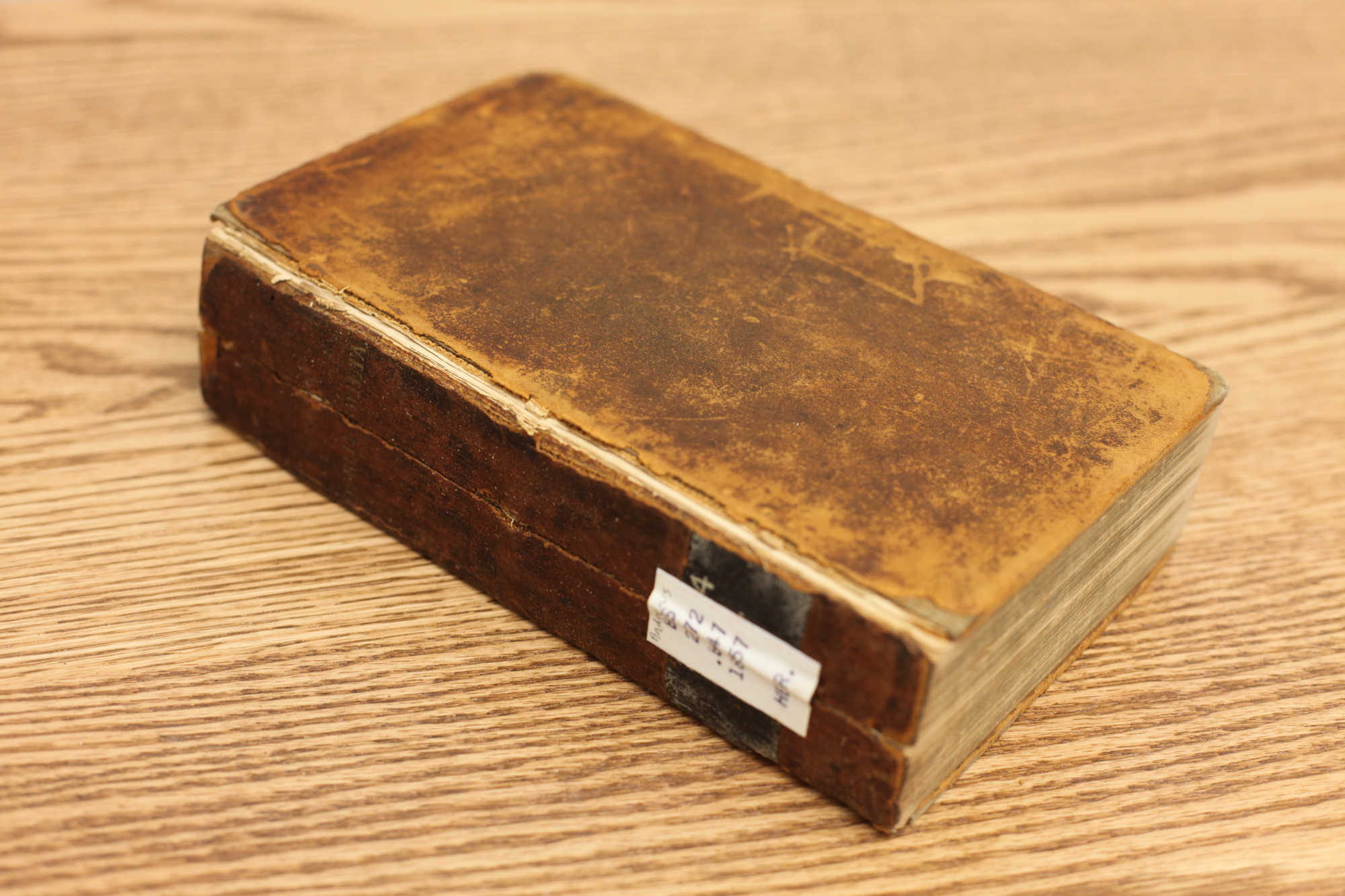
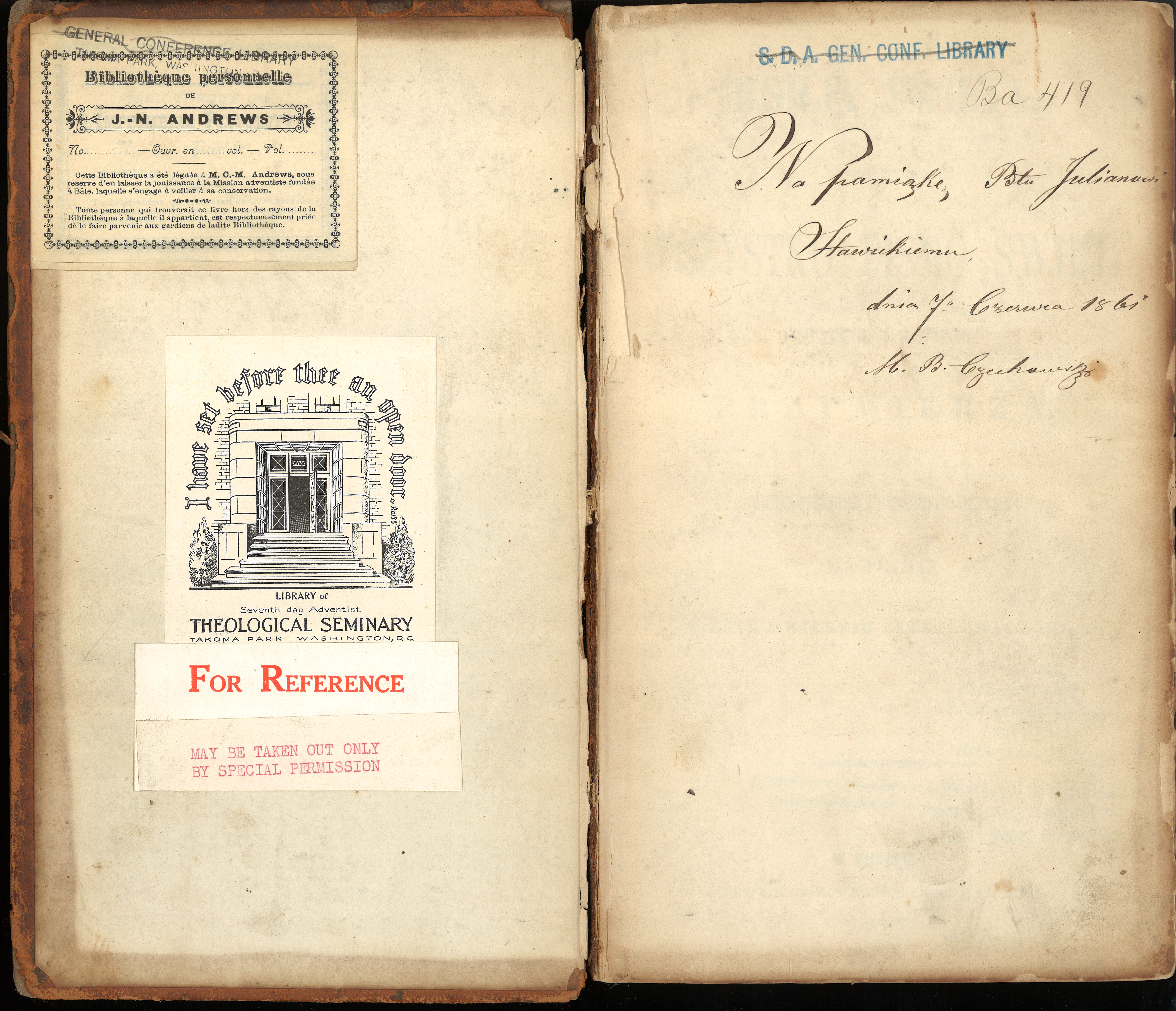
Bible  M. B. CzechowskiWhile doing some research in the Center’s vault Merlin D. Burt recently discovered that one of the Bibles in the John Nevins Andrews library had Czechowski’s signature in it.
A native Polish speaker, Darius Jankiewicz, gave us a translation of the handwritten note as follows:

“As a keepsake (or memento) for Brother Julian Stawicki, on June 7, 1861.”

In other words this is a gift for Julian to remember Czechowski. Stawicki now owns the Bible. So it must have been a gift from Czechowski. A paraphrase would be: “A gift so that Brother Julian Stawicki remembers me.”

This was an interesting and not widely known fact, so it was decided to post some pictures of the Bible on Facebook. Denis Kaiser, a fan of the Center’s Facebook page and worker at the Center, found further information on Czechowski and Stawicki.

Stawicki was one of Czechowski’s converts to the Seventh-day Adventist faith in New York in 1860. See M. B. Czechowski, “The N.Y. Mission,” Review and Herald, Sept. 4, 1860, 124, 125; Julian Stawicki, “From Bro. Stawicki,” Review and Herald, Aug. 26, 1862, p. 103.

Bible with note written by M. B CzechowskiIn the summer of 1861 Czechowski moved from New York City to Enosburg Falls, in the northern part of Vermont near the Canadian border. It may well be that Czechowski gave this Bible to Stawicki upon his departure. The date in the Bible (June 7, 1861) could actually help date Czechowski’s departure more precisely than just summer 1861.

Of course, that doesn’t explain how it got from Stawicki to Andrews. It is, however, interesting that Stawicki’s name appears only in the Review and only in 1860 and 1862. Further research has to be done to discover more about Stawicki’s whereabouts after 1862. Maybe he defected from the faith, as there doesn’t seem to be an obituary for him in church periodicals.
Like all good research projects, this additional information by Denis has answered some questions but raised others. It is an interesting connection between these two pioneer missionaries to Europe. A former Catholic priest, Czechowski joined the Seventh-day Adventist church in 1857 and some time later asked the General Conference to sponsor him to be a missionary to Europe. The fledging denomination did not feel it was the right time, and said no. However Czechowski was not deterred and left in 1864 as a missionary to Europe. There he worked for several years sharing the Adventist message. He died in Vienna in 1876. Andrews left for Europe as a missionary in 1874. The story of how this Polish bible with Czechowski’s signature arrived in the personal library of J. N. Andrews is one yet to be discovered.

Pitcairn Materials Donated

Duane and Nancy Anderson and family donated several items related to Pitcairn Island which had belonged to Nancy Anderson’s father, Mr. Robert M. Little II. He made the model of H.M.S. Bounty himself by purchasing a boat and modifying it more closely resemble the Bounty. As no one else in the family was interested in Pitcairn and its relation to Adventist history, the Andersons thought to donate the materials to the Center for Adventist Research.

A woman and man standing with a model of a sailing vessel.

Nancy and Duane Anderson standing with the model of the H.M.S. Bounty which Nancy’s father, Robert M. Little II, had made by purchasing a boat and modifying it to more closely resemble the Bounty.

The H. M. S. Bounty has a storied history. Many know the tale from the movies and books written about this true adventure of the mutiny of the sailors who took refuge on Pitcairn Island.

The Seventh-day Adventist connection starts in 1876 when James White and J. N. Loughborough sent a volume of the Signs of the Times and some tracts, accompanied by a letter, to Pitcairn Island. Loughborough writes in his book The Great Second Advent Movement “We knew not a person on the island, and knew nothing of the island itself, save its reputation as having for its inhabitants a devoted, godly people. The papers were sent as a venture.” (p.427) Later John I. Tay, a Seventh-day Adventist ship’s carpenter, spent five weeks on Pitcairn and persuaded the islanders to keep the seventh-day Sabbath.

In the 1890s as part of a Sabbath school fund raising campaign a mission boat was built. They named it Pitcairn and it was launched November 25, 1890. For ten years the Pitcairn sailed the south pacific with missionaries on board. Pitcairn Island was a regular stop on its route.

Here is an extract from a letter from a Pitcairner, which throws an interesting light upon the life on Pitcairn Island:-“H.M.S. — came in yesterday. Sabbath, the captain came ashore and attended the Sabbath school. He offered the opening prayer, reviewed the primary division, and at the close gave a parting address to the whole school. He expressed himself as highly pleased with our school system, and was so glad that all the people attended. He said our school is the best organised school he ever saw, and he had seen many, for when at home in England he was superintendent of a Sunday-school. He is a really Christian man.”{The Present Truth (UK) August 2, 1894, p. 496.17}

The Seventh-day Adventist church now has a worker and a nurse who come from Australia who serve two-year terms on Pitcairn Island.

The Pitcairn collection items are in the process of being digitized and will be available soon to researchers.