Commendation for Gilbert M. Valentine

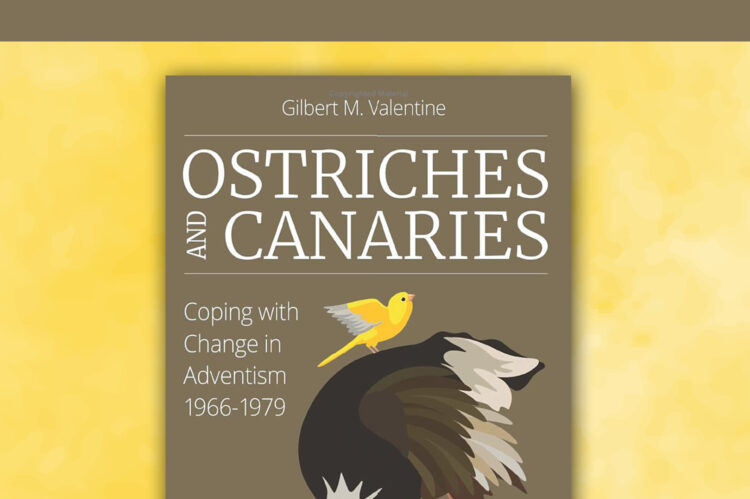
Gilbert M. Valentine’s laudable book, Ostriches and Canaries: Coping with Change in Adventism, 1966–1979 (Oak and Acorn, 2023), was selected as a finalist for the Center for Adventist Research Book Prize and warrants accolades. Valentine broke new ground in his masterfully interpreted history of Robert Pierson’s administration and its impact, especially on Andrews University and Loma Linda University. Few historians have studied Adventism in the twentieth century and Valentine is the first to investigate debates over academic freedom within the Seventh-day Adventist Church. Ostriches and Canaries is delightfully provocative and especially relevant, as incidents in the recent Adventist past have shown. Valentine’s research is impeccable, reflecting his well-known talent as an archival sleuth and brilliant analyst. His prose is also compelling—indeed, Ostriches and Canaries is a riveting page-turner! Thus, for many reasons, we highly commend Gilbert M. Valentine for his excellent narrative, Ostriches and Canaries.

Author: Center for Adventist Research Prize Committee
Commendation for the Oxford Handbook of Seventh-day Adventism

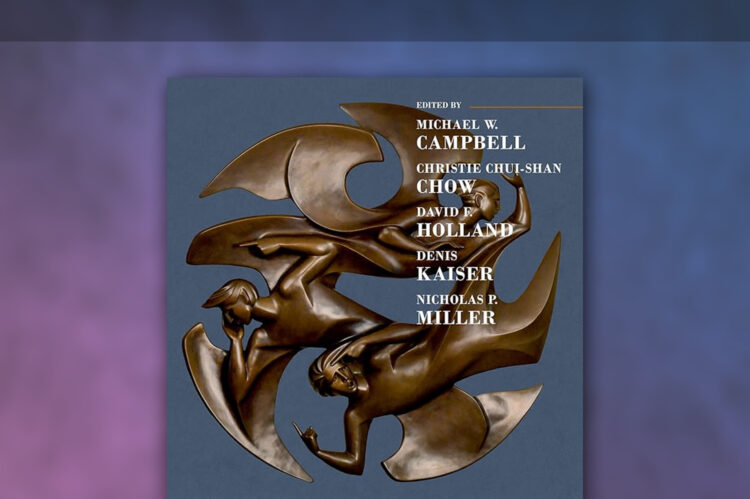
We believe that the Oxford Handbook of Seventh-day Adventists (Oxford University Press, 2024) deserves an honorable mention. This is the first reference work to be published by an elite university press and for this reason alone (but there are also many others) it significantly advances Adventist Studies. The work is skillfully edited by Michael W. Campbell, Christie Chui-Shan Chow, David F. Holland, Denis Kaiser, and Nicholas P. Miller, and the chapters are clear, concise, and attractive to a broad audience. Most chapters provide a masterful survey of the field and several offer cutting-edge perspectives on familiar subjects. For many reasons, this work is worthy of high commendation.

Author: Center for Adventist Research Prize Committee

Denis Kaiser Receives Inaugural 2025 Center for Adventist Research Book Prize

Commendation for Denis Kaiser

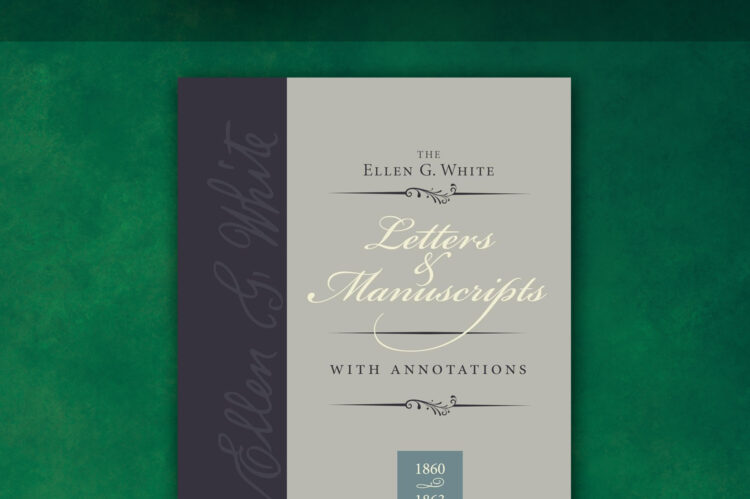
The inaugural Center for Adventist Research Book Prize is awarded to Denis Kaiser for his work on The Ellen G. White Letters & Manuscripts with Annotations, vol. 2, 1860–1863 (Review and Herald, 2024). This work was skillfully edited by Timothy L. Poirier and Dwain N. Esmond and Kaiser served as the lead annotator and author of the biographical sketches in this invaluable 1100-page resource.

Kaiser’s work is thoroughly researched, evidently reliable, and compellingly persuasive. He masterfully interpreted his sources with an uncommon level of precision, and his employed research methods were immensely relevant to his project. His writing is exceptionally clear, concise, accessible, and engaging. With thanks to the editors, the work is well-organized and reflects a clearly logical progression of ideas and divisions. Moreover, this publication is also highly attractive, featuring numerous illustrations, including ten beautifully designed maps—the work of Siloe Oliveira—that show Ellen White’s travel routes between 1860 and 1863.

Kaiser’s work clearly addresses thought-provoking themes and relevant subjects in American history, such as the Civil War and health reform. He also intelligibly situates Adventism within its broader historical context, demonstrating where Adventists fit within their milieu. These factors, as well as Ellen White’s prominent public profile, make Kaiser’s work exceedingly relevant to a broad audience, including non-Adventist scholars.

Perhaps most importantly, Kaiser’s work clearly generates new knowledge and insights that advance the field of Adventist Studies and promise to shape the future of the discipline. This is evident through the painstaking work Kaiser did in identifying partially named individuals in Ellen G. White’s writings, deducing the approximate dates for undated letters and manuscripts, and clarifying myriads of minute details that facilitate the interpretation of White’s literary corpus and bring her life, work, and world into sharper focus. However, Kaiser’s most notable contribution is perhaps reflected in the more than 100 biographical sketches that he wrote for this volume, many of which focus on Adventists previously unknown to historians. To date, Adventist historiography has primarily focused on white male leaders, institutions, or theological developments, but the biographical sketches of women and men that appear in the two volumes of this annotation series are significantly focused on the Adventist people. The Adventist people did, in fact, comprise the overwhelming majority of the church membership, but this lay demographic is still largely unknown. Therefore, this collective biographical lexicon, perhaps more than any other works thus far published on Adventist history, provides an unrivaled foundation for historiographical advancements, particularly in relation to social, cultural, and political history. Since Kaiser’s work on the Ellen G. White Letters & Manuscripts with Annotations deepens our knowledge of Adventist history in many crucial ways and will undoubtedly enrich future scholarship on America’s most successful female religious founder and the church she led, this work receives our highest commendation, and we are proud to award Denis Kaiser the 2025 Center for Adventist Research Book Prize.

Commendation for the Oxford Handbook of Seventh-day Adventism

We believe that the Oxford Handbook of Seventh-day Adventists (Oxford University Press, 2024) deserves an honorable mention. This is the first reference work to be published by an elite university press and for this reason alone (but there are also many others) it significantly advances Adventist Studies. The work is skillfully edited by Michael W. Campbell, Christie Chui-Shan Chow, David F. Holland, Denis Kaiser, and Nicholas P. Miller, and the chapters are clear, concise, and attractive to a broad audience. Most chapters provide a masterful survey of the field and several offer cutting-edge perspectives on familiar subjects. For many reasons, this work worthy of high commendation.

Commendation for Gilbert M. Valentine

Gilbert M. Valentine’s laudable book, Ostriches and Canaries: Coping with Change in Adventism, 1966–1979 (Oak and Acorn, 2023), was selected as a finalist for the Center for Adventist Research Book Prize and warrants accolades. Valentine broke new ground in his masterfully interpreted history of Robert Pierson’s administration and its impact, especially on Andrews University and Loma Linda University. Few historians have studied Adventism in the twentieth century and Valentine is the first to investigate debates over academic freedom within the Seventh-day Adventist Church. Ostriches and Canaries is delightfully provocative and especially relevant, as incidents in the recent Adventist past have shown. Valentine’s research is impeccable, reflecting his well-known talent as an archival sleuth and brilliant analyst. His prose is also compelling—indeed, Ostriches and Canaries is a riveting page-turner! Thus, for many reasons, we highly commend Gilbert M. Valentine for his excellent narrative, Ostriches and Canaries.

Author: Center for Adventist Research Prize Committee
Benjamin J. Baker Receives Inaugural 2025 Center for Adventist Research Article Prize

Commendation for Benjamin J. Baker

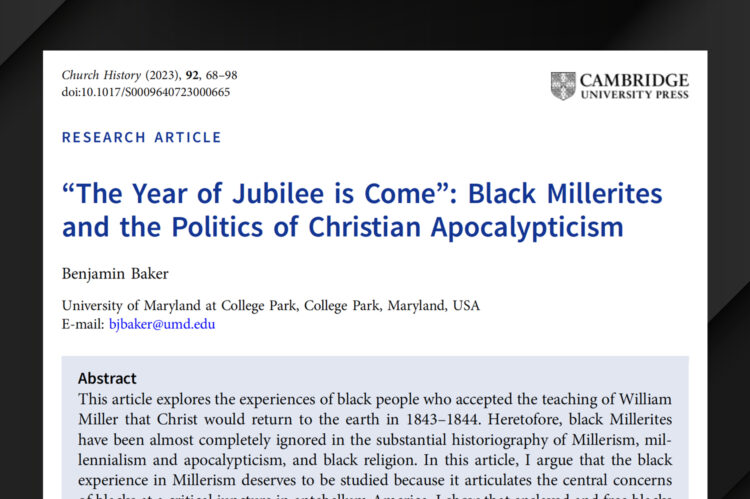
The inaugural Center for Adventist Research Article Prize is awarded to Benjamin J. Baker for his pathbreaking article, “ ‘The Year of Jubilee is Come’: Black Millerites and the Politics of Christian Apocalypticism,” published by the prestigious journal, Church History, in 2023.

Baker’s cutting-edge work intervenes in three major fields of study: Adventist, apocalyptic, and Black studies. Baker’s pioneering article is the first analytical history of Black Millerites in the antebellum United States. Previous historians had virtually ignored Black Millerites. A survey of the historiography reveals that only eight Black Millerites had been identified in published sources and, with exception of some studies on Sojourner Truth, the Millerite faith of these men and women was only mentioned anecdotally across a variety of scattered works. Therefore, before Baker could offer his preeminent analysis of Black Millerism he first had to undertake the laborious task of recovery history.

Baker also made a significant contribution to apocalyptic studies. The so-called premillennial/postmillennial binary has long dominated research on apocalypticism, asserting that Christian premillennialists avoid politics and social engagement. Historians who have recognized that Black apocalypticists in the nineteenth century were highly active, have either assumed that these men and women were postmillennialists (an eschatology incorrectly linked with progressive politics) or refused to interrogate their eschatological beliefs. However, Baker is among a notable group of avant-garde historians who are challenging near consensus views on apocalypticism by demonstrating that premillennialism can fuel progressive politics in America and that postmillennialists did not necessarily take on this role.

Baker’s prescient work on Black Millerites finally reveals that apocalypticism was a powerful force that helped untold thousands make sense of the Black experience in antebellum America. As Baker argues, “Black Millerites used the apocalyptic for coping with perpetual oppression, individual betterment, greater confidence in activism, instantiating egalitarianism, corporate visioning, and reinvigorating the struggle for freedom—all to hasten their eventual emancipation and expand democracy in America.” On this score, Baker challenges historians to take apocalypticism seriously, rather than dismiss groups like the Millerites as crazy or misguided, because these movements unmask “the dysfunction and injustice in society and people’s response to it.”

Baker’s article on Black Millerism has been assigned as required reading in both undergraduate and graduate courses on American and American religious history since its publication. This work has already made an indelible mark on the historiography and for these reasons this work receives our highest commendation, and we are proud to award Benjamin J. Baker the 2025 Center for Adventist Research Article Prize.

Author: Center for Adventist Research Prize Committee